

Four Simple Ways to Make Your Street Safer
by Julian A.S. — Most of our neighbourhood streets are poorly designed, but we could make them safer tomorrow with just a few quick changes.


by Julian A.S.
From my bedroom I hear a sporadic parade of scraping noises. The distinctive grating of plastic on asphalt. I hear it multiple times a day, every single day, morning, noon, and night. It's the sound of speeding cars sailing over the lone speed bump on my residential street. Most drivers slow momentarily for the bump, but many fail or decline to do so. And even those who do slow down almost always continue to speed once they’re clear.
If you live in North America, a scene like this is probably all too familiar. But why is it so easy for drivers to speed through our neighbourhoods, and how can we slow them down?
We tend to design local streets with the same underlying approach that we use to design highways and other major vehicle thoroughfares. You probably know what I’m talking about intuitively because your street likely looks something like mine: wide, straight, and uncomplex. The problem is that roadways like this are good at what they were designed to do, which is to enable drivers to go fast.
When our local streets inevitably become dangerous because they are designed like high-speed roads, we often reach for half-measures like lower posted speed limits. Most drivers, however, don’t stare at their speedometer while they drive. More often, drivers base their speed on intuition, on how fast feels appropriate in the environment.
Essentially, a wide, straight road will encourage people to drive fast, while a more complex environment will naturally encourage them to slow down. And clearly, a haphazard smattering of speed bumps around a neighbourhood is not a sufficient intervention on its own.
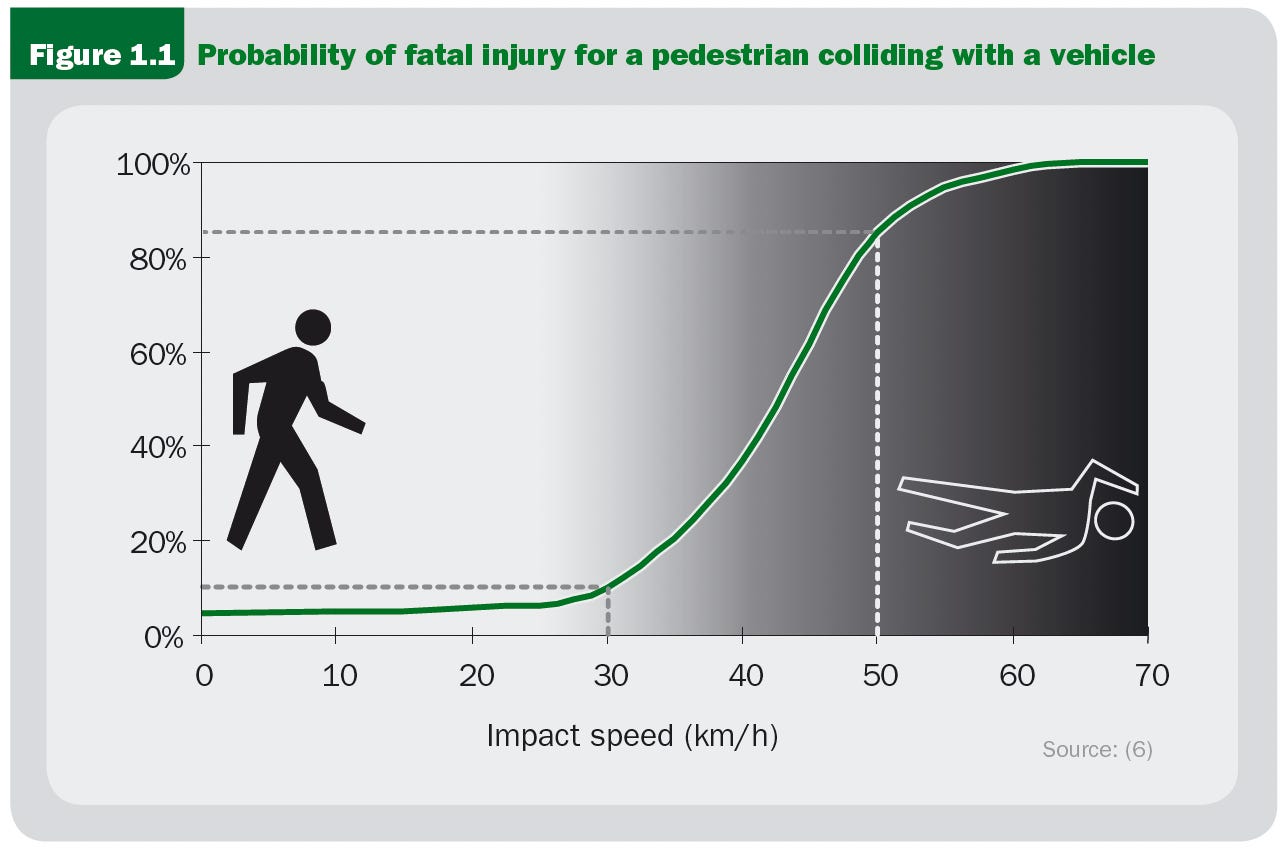
Slowing cars down on neighbourhood streets is crucial because the lethality of being struck by a motor vehicle increases dramatically with vehicle speed. When struck by a vehicle traveling at 30 km/h, pedestrians have around a 90% chance of survival. At 50 km/h, that likelihood drops to just 20%. Not to mention the severity of non-fatal injuries. As a driver, cruising slightly above the speed limit may seem trivial, but the difference of just a few kilometers per hour can make a serious difference in the outcome of a collision.
Because the presence and speed of motor vehicles presents a direct danger to anyone outside of a car, it is important to reduce the number of motor vehicles in neighbourhoods as much as reasonably possible—but that will require a broader cultural shift, and that is a conversation for another time. In the meantime, it is crucial to lower the speed of vehicle traffic, and to improve the visibility of pedestrians, cyclists, and other more vulnerable road users.
Thankfully, we know that there are straightforward and inexpensive interventions that can help mitigate the most immediate dangers presented by cars! The following is a brief introduction to some simple traffic calming infrastructure that can make our streets safer for everyone by intuitively and subtly changing driver behaviour.
1. Curb Extensions
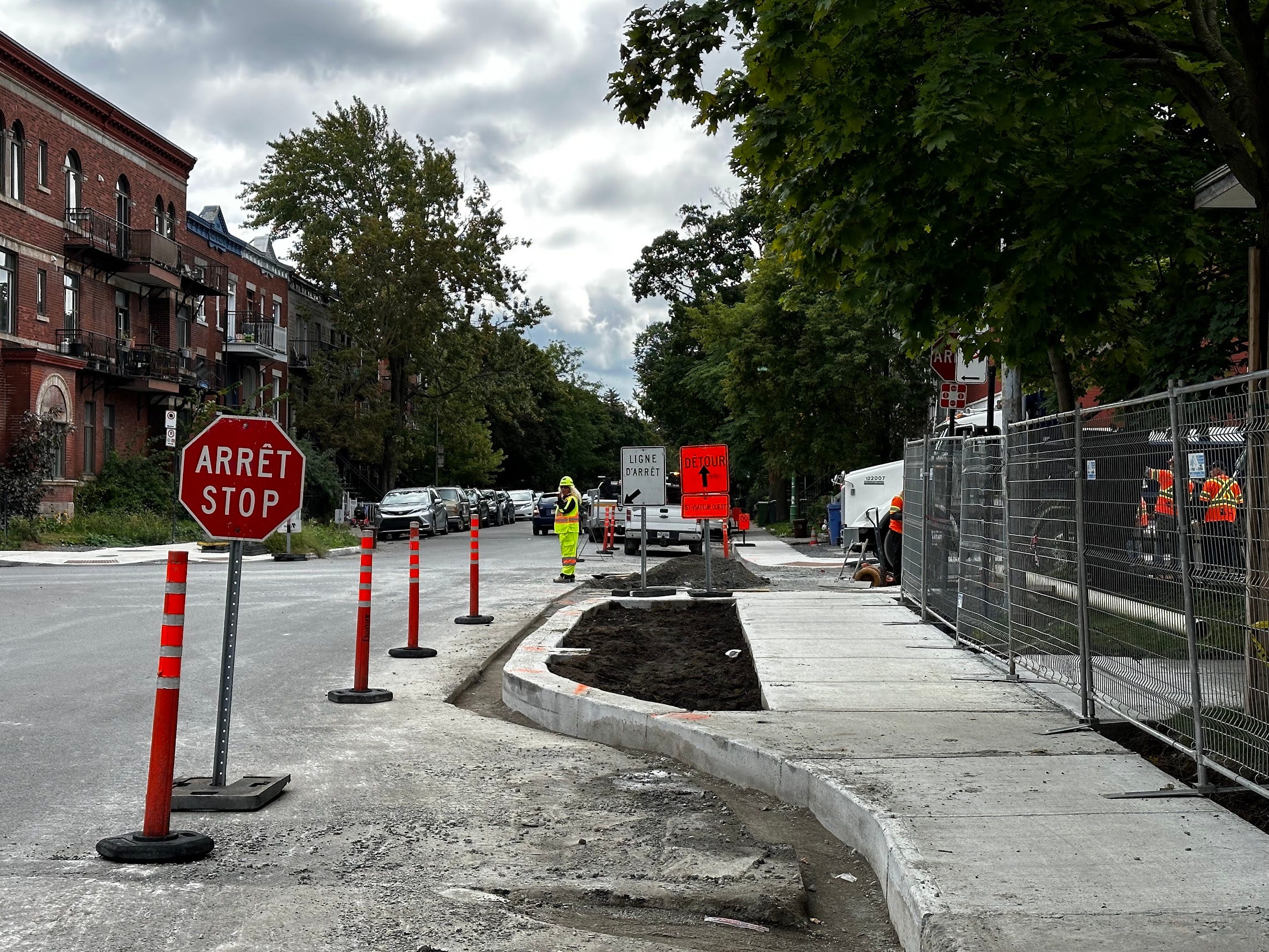
Curb extensions work by narrowing the roadway at intersections or other potential points of conflict, such as midblock crosswalks. This improves pedestrian visibility—a practice called ‘daylighting’ in the jargon—by minimizing the likelihood that people beginning to cross are obstructed by parked vehicles, rendering them more visible to oncoming traffic and vice versa. Curb extensions also reduce the duration that pedestrians are vulnerable in the roadway by shortening the distance that they must cross. Crucially, a narrowing roadway also intuitively forces drivers to slow down and pay more attention as they enter, reducing the likelihood and severity of potential collisions.
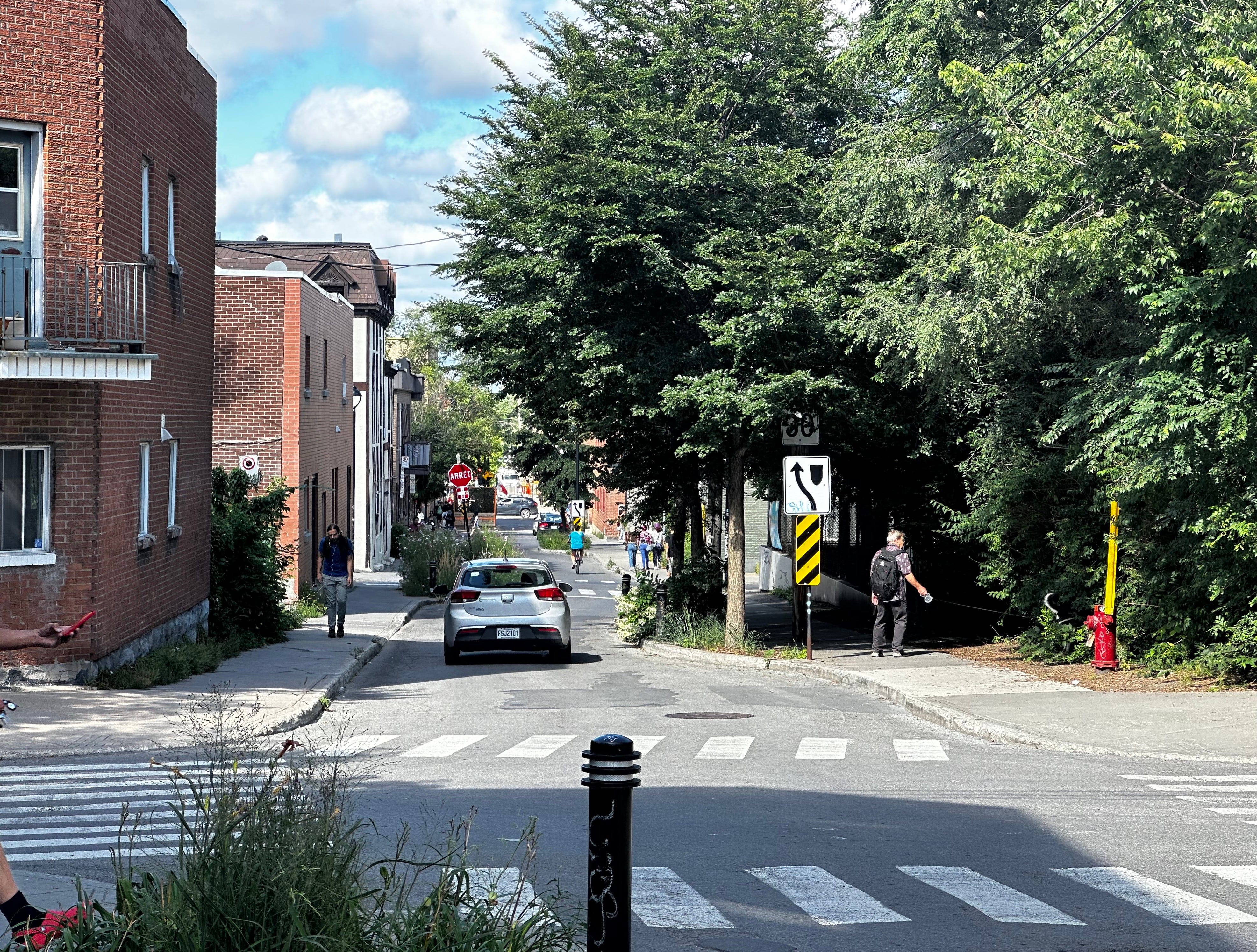
Beyond just improving safety, curb extensions can also bring practical and/or aesthetic improvements to a street. For example, by creating room for new green space like small gardens, urban furniture like public tables or benches, or stormwater mitigation cells.
2. Traffic Circles
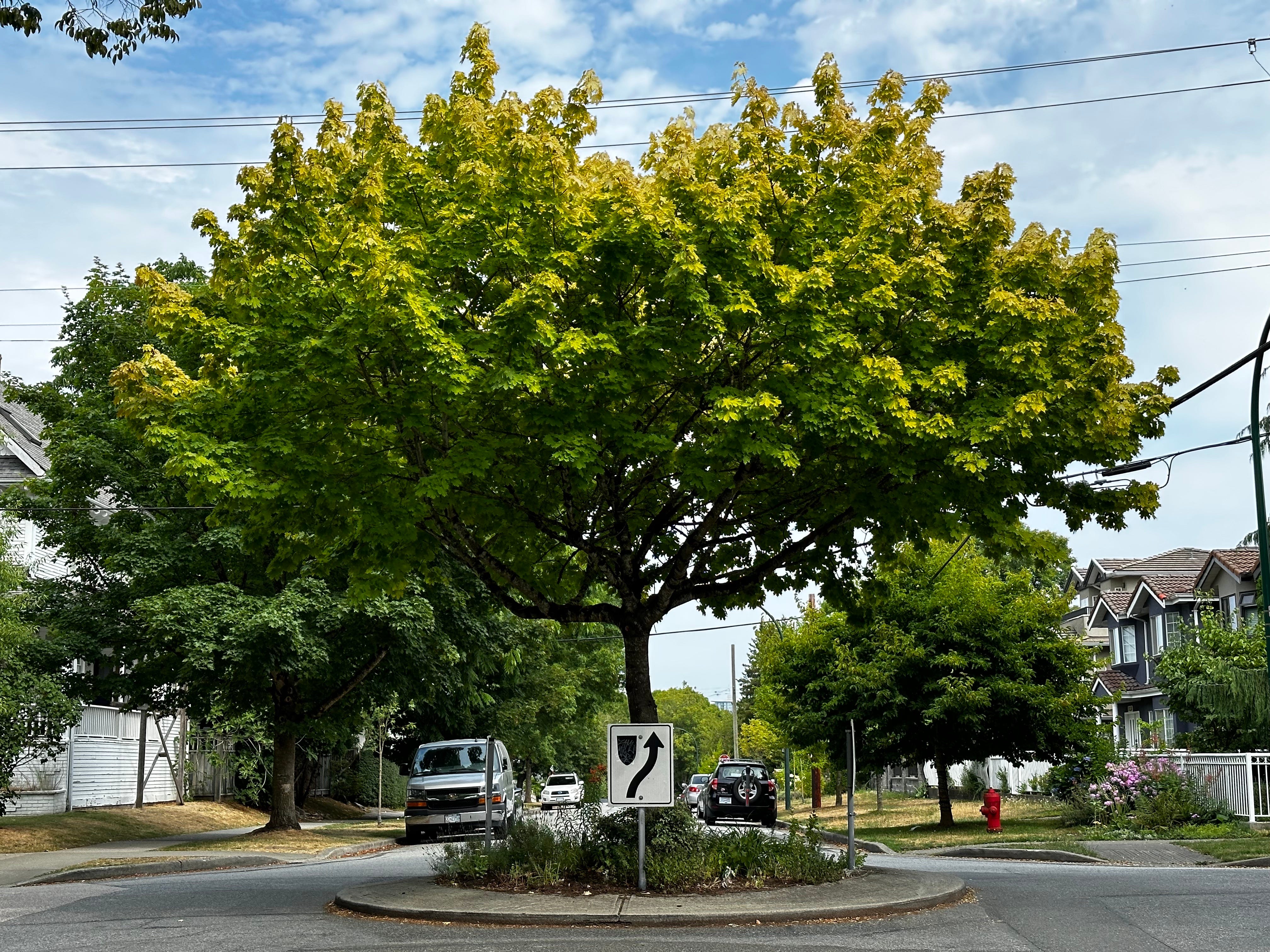
Roundabouts don’t need to be big and scary! Small traffic circles are a great alternative to stop signs even at quiet intersections. They’re much harder to roll or blow through than a stop sign. Traffic circles force all road users to slow down as they enter an intersection, to actively watch out for others, and also drastically reduce potential conflict points between road users by simplifying the flow of traffic.
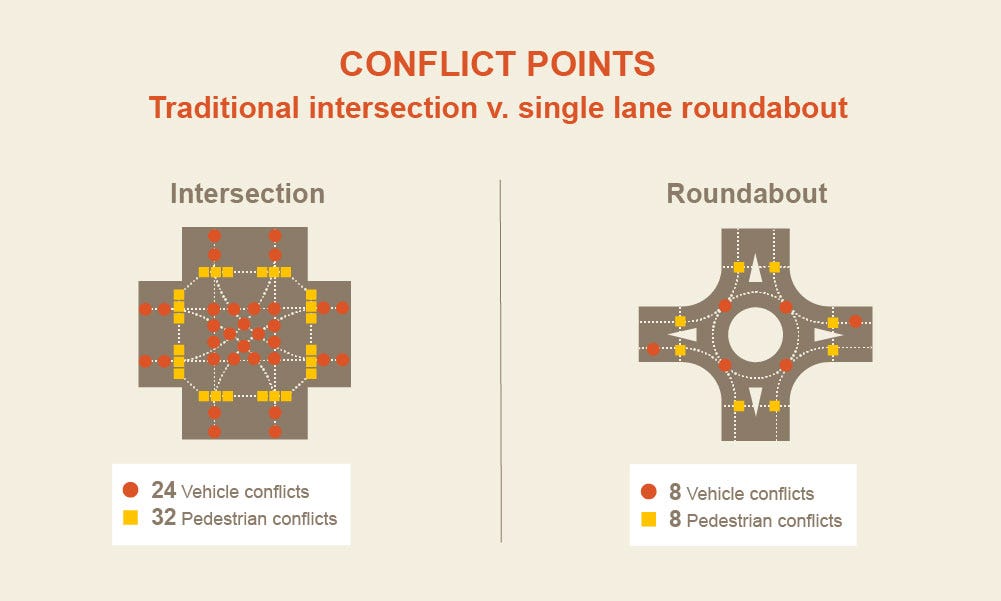
Furthermore, because traffic circles force road users to slow down often without coming to a complete stop—unless necessary to yield the right of way—they maintain the movement of traffic along a street much more efficiently than being forced to stop every block at a four-way stop. This makes traffic circles especially appropriate on bike routes or other active transportation corridors, where it is desirable to avoid forcing non-motorized vehicles to repeatedly come to a complete stop.
Improving the flow of low-speed traffic through a neighbourhood while also rendering individual intersections less dangerous is a pretty clear win-win.
3. Modal Filters
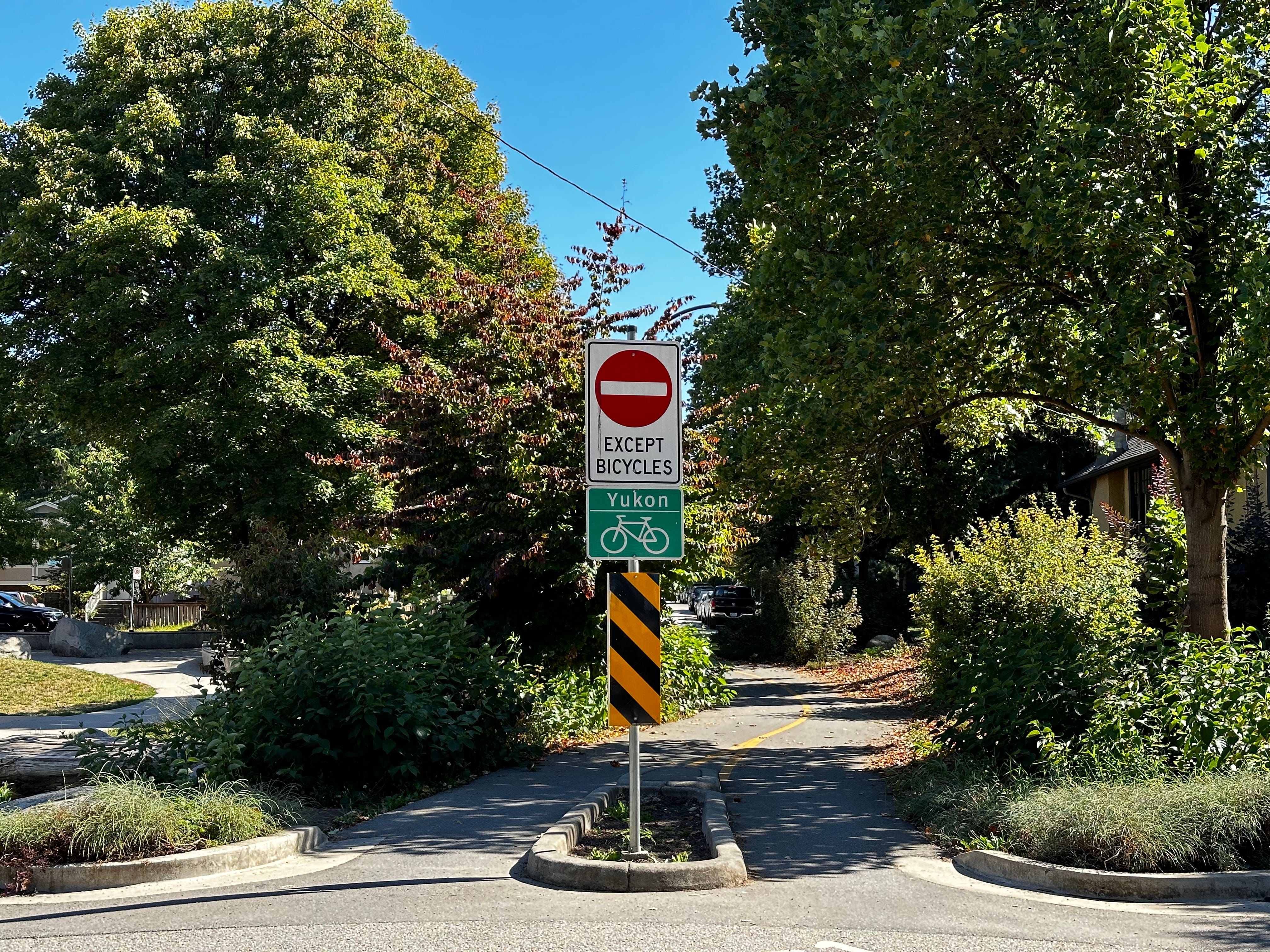
Modal filters allow only certain types of traffic to pass, for example by permitting cyclists and pedestrians to continue but not motor vehicles. Modal filters are a great way to discourage vehicle through traffic from taking shortcuts through quieter streets by making these routes slightly more circuitous and therefore only desirable to local traffic. Strategically limiting the presence of cars while still offering the most direct route possible to others is also a great way to encourage people to use alternative transportation methods like walking, cycling, or transit.
Once again, modal filters make great opportunities for improved landscaping or public amenities, but can also be as simple as a couple of concrete blocks or planters in the roadway. It is also possible to maintain access for emergency or service vehicles in locations where this is deemed particularly important, for example by installing collapsible bollards in place of immovable barriers.
4. Raised Crosswalks
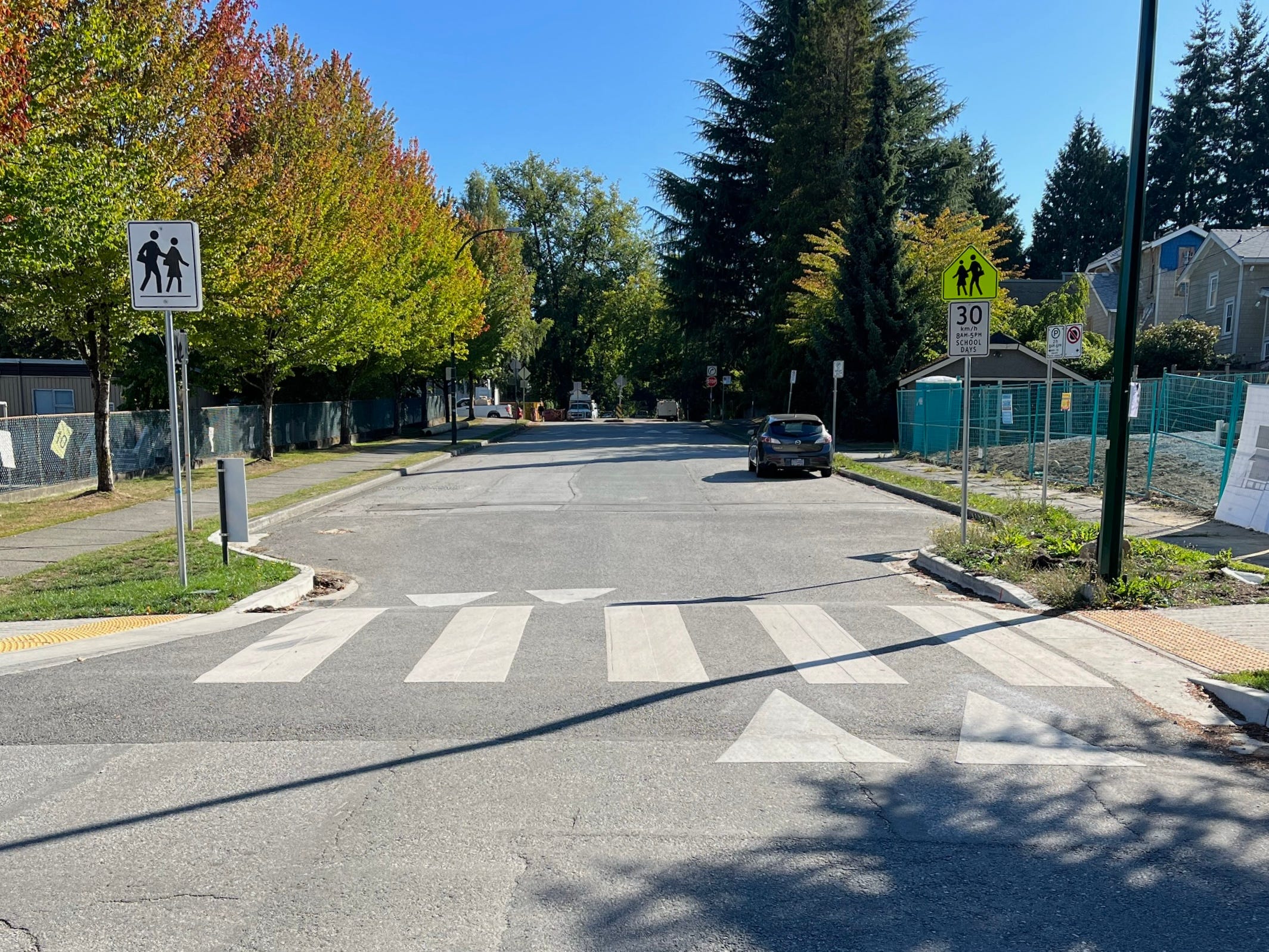
Raised crosswalks work by bringing a portion of the roadway to the height of the sidewalk. This vertical change naturally encourages drivers to reduce their speed in the same manner as a speed bump, however raised crosswalks differ from speed bumps in their size and placement. They are horizontally larger than speed bumps, meaning the entire vehicle is generally in the raised section at once, and are also placed at likely points of conflict. By slowing traffic at locations where collisions between vehicles and vulnerable road users are the most likely, their benefit is maximized.
These can be designed with varying degrees of simplicity. The implementation pictured above is essentially just an enlarged speed bump placed at the crosswalk, which is not ideal, but demonstrates just how easily this infrastructure can be installed. A better implementation would be to build the raised crosswalk out of the same material as the sidewalk, which would further visually distinguish the crossing from the roadway.
These same principles can also be applied to entire intersections.
Beyond just physically slowing down vehicles, raised crosswalks and intersections also have the effect of changing the subconscious hierarchy between motor vehicles and other road users. Instead of pedestrians and other vulnerable groups being forced to enter the roadway, motor vehicles are instead brought to the level of the sidewalk, so the visual and physical change naturally encourages drivers to slow, watch for others, and yield. This is particularly important because it reinforces that our neighbourhoods belong first and foremost to people, not vehicles.
I don’t think that most drivers are bad people who are consciously choosing to put others at risk. Instead, I think that many are lulled into a false sense of security by—at least in part—bad urban design which facilitates and normalizes dangerous behaviour.
Highways and arterial roads will always be part of our transportation networks, but we should be concerned with how much the places we live our lives—our streets—resemble places that are designed primarily for cars. It shouldn’t be so easy to drive so carelessly, especially in a residential area.
All of these design interventions work by subtly changing the built environment in ways that naturally encourage drivers to slow down and to pay increased attention to their surroundings. In effect, the infrastructure is self-enforcing. The safer and more appropriate driving behaviour is intuitively designed into the physical roadway. We don’t need a cop sitting at the end of every block looking to penalize unsafe driving if we can design our cities to prevent it in the first place!
This simple infrastructure just requires a little planning, a little concrete, and a little landscaping. It is not massively ambitious or expensive to implement, and can be deployed strategically (or better yet, broadly) to incrementally improve the safety of neighbourhood streets without necessitating a massive overhaul of the road network.
Some cities are proactively pursuing these interventions, for example by including curb extensions by default in most street repair projects. Others are slower to adapt.
If you’re lucky enough to see changes like this in your neighbourhood, hopefully you better understand and appreciate the benefits of this simple traffic calming infrastructure. Or, if you’re starting to think that your neighbourhood street resembles a highway a bit too much for your liking, it might be time to get in touch with your city council!
For now, my street remains an accident waiting to happen. Each time I hear that scraping sound outside my bedroom window, I wince a bit. One of these days, it won’t just be plastic striking the road at high speed—it will be flesh and bone, too. That’s a sound I hope no one ever has to hear.