

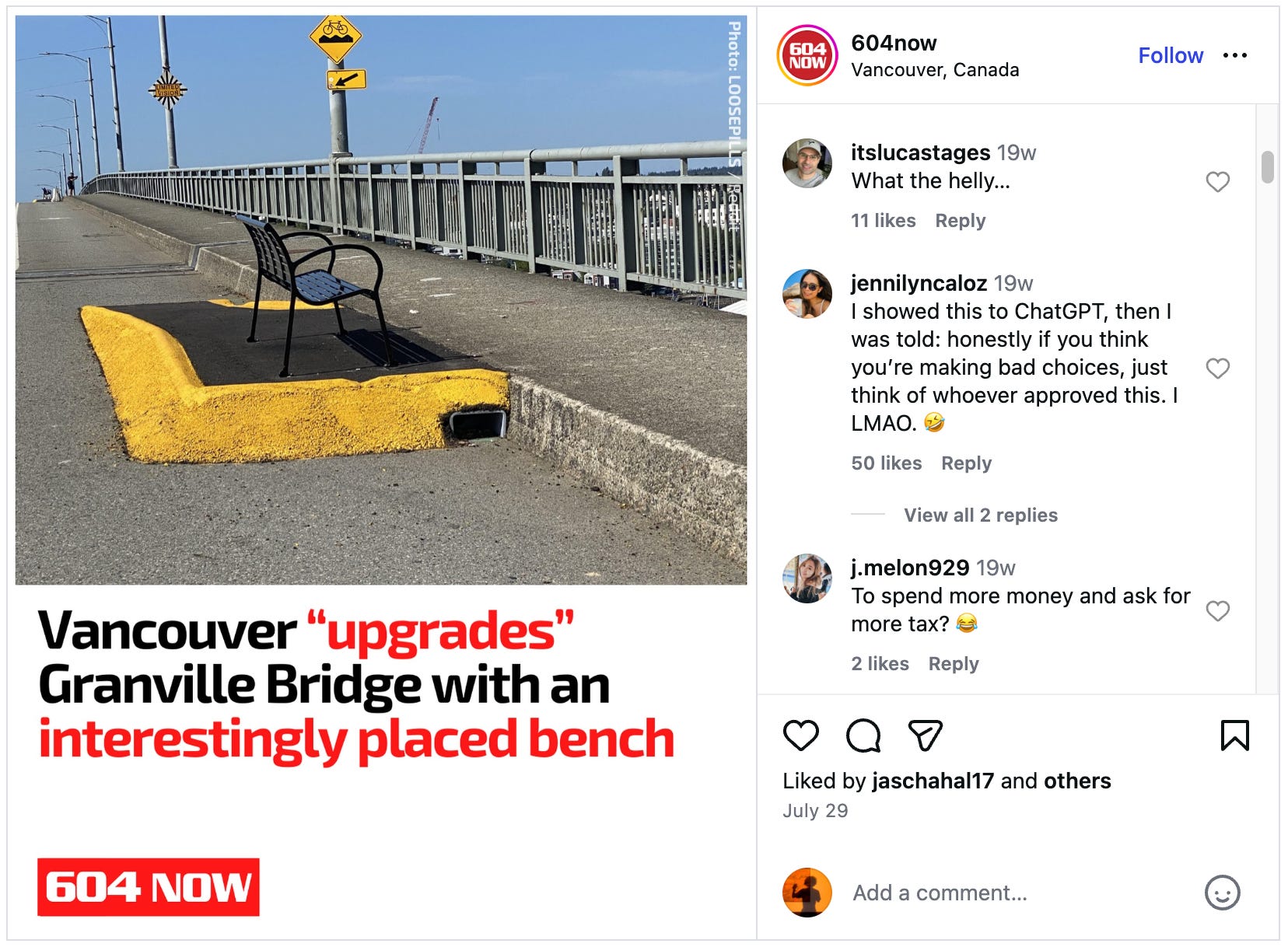
Have you seen this bench? If your social media algorithm is swayed by your physical or cultural proximity to Vancouver, you likely have. A black metal bench bolted haphazardly to an asphalt ramp apparently in the middle of the roadway on a busy bridge. This strange sight went somewhat viral this summer shortly after it was unveiled to much ridicule and scorn. At first glance, yes, the now-infamous bench looks a bit silly—but seeing it so maligned made me sad. I believe that the clunky aesthetics of this bench belie the genuine improvement to the city that it represents.
This viral bench was, in fact, just one in a series of new benches installed on the Granville Bridge during the recent work for the Granville Connector project. This project has been underway for several years, and involves structural maintenance on the 71-year-old bridge, the installation of new traffic signals, the deconstruction of freeway-style offramps, and a redesign of the nearby street network. Most transformatively, the project has also reallocated road space on the west side of the bridge for a much wider walkway and two-way bike lane. It is along this new protected promenade, which opened to the public this July, that the offending benches were installed.
For many Vancouverites, a viral image of an ugly bench was their first and only introduction to the Granville Connector project. Alternatively, for those who were already familiar with the project, the spartan aesthetics clashed with expectations created by beautifully-landscaped design renderings of the project in its best (read: properly funded) form. Incredulous disparagement ensued.
On the one hand, the half-quippy-half-acetic discourse might not seem like such a big deal. The bench looked ridiculous, and was thoroughly ridiculed. So what? An image going viral divorced from its context is typical of a social media culture that is very interested in symbolism and outrage and less so in nuance or detail. But there is a deeper cynicism here that troubles me. People seem to be so despondent about the ability of government to accomplish anything that even evidence of progress somehow still serves to confirm the opposite. People see an awkward bench, a multi-year timeline, and a $54 million price tag and immediately conclude that the obvious explanation is corruption and/or incompetence; that the taxpayer is being swindled. Of course, this project was much more comprehensive in scope than a cursory glance at a bench meme or Facebook comment section would indicate.
And the project is good—even in its current half-realized iteration. The Granville Bridge is now far more useful to a broader swath of the population, and for more purposes, than it has ever been before. There are new ways to get around, and the city and its residents are unequivocally better for it.
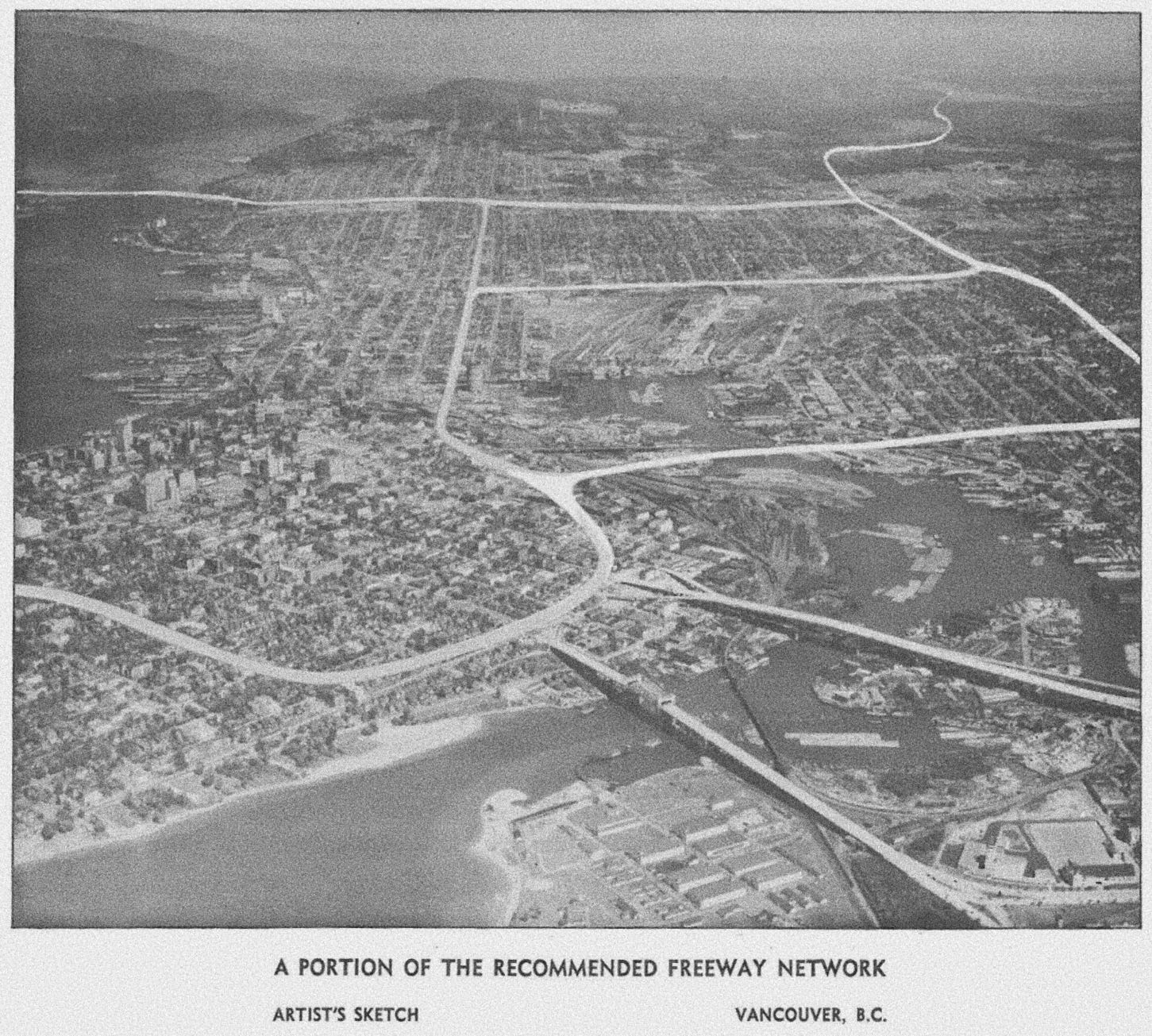
As one of only three bridges spanning False Creek, connecting Downtown Vancouver with neighbourhoods to the south, the Granville Bridge had long been misallocating its limited real estate. Built in the early 1950s, the bridge was designed to carry eight lanes of freeway traffic into and out of the downtown core. Thankfully, the connecting freeway projects which would have decimated the city centre were abandoned, but the bridge retained its original design. Over the course of the last seven decades, this small piece of highway became more and more incongruous with the increasingly dense urban neighbourhoods growing around it. It provided far more capacity than was ever necessary for cars, while providing effectively no capacity for other uses. Crossing the bridge on foot meant traipsing along a narrow sidewalk with a 30-meter drop to one side and fast-moving vehicles (no barrier, just a curb) on the other. Cycling meant competing for this precarious sidewalk space, or braving highway-speed traffic on a roadway with no shoulder and poor sightlines.
In other words, most people outside of a car avoided the Granville Bridge like the plague. It has long been an obvious candidate for an update that would make it less the wet dream of a 1950s General Motors executive and more something that serves Vancouverites in the 21st century. Yet when these improvements finally materialized, the tenor of the discourse was that of disdain and disbelief over a silly-looking bench taken out of context. What a shame.
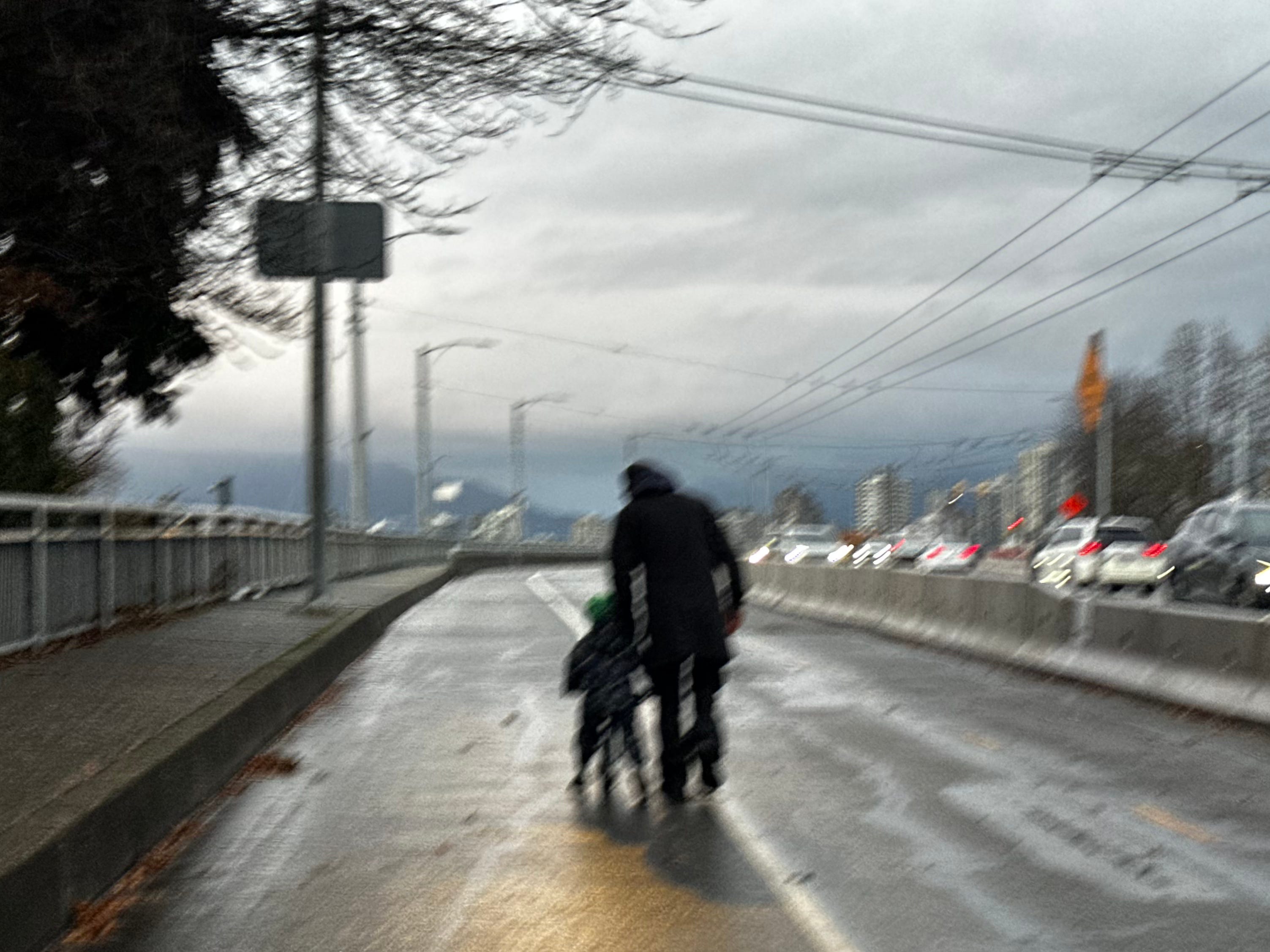
I was running over the Granville Bridge recently—something which I always avoided prior to the Granville Connector project because of how unpleasant and dangerous it was—when I was struck by a novel sight. A father was teaching his toddler how to ride a bike in the new protected promenade area. This scene almost stopped me in my tracks. It is very possible that I was witnessing something that had never happened before in the 71-year history of this bridge.
It really brought home to me the most amazing part of this transformation, beyond just the vastly improved mobility infrastructure: there is a place here where before there was only high-speed car traffic. A place to go for a run; a place to sit on a bench and watch the sunset over English Bay; a place to teach your son how to ride a bike.
These kinds of improvements are not always flashy, but they are crucial to making our cities more livable. Maybe Vancouver’s saddest bench isn’t so sad after all.